Named referrals in eReferral: what GPs need to know
More information about referrals to Specialist Outpatient Services at the Tasmanian Health Service can be found here.
Named referrals in eReferral: what GPs need to know
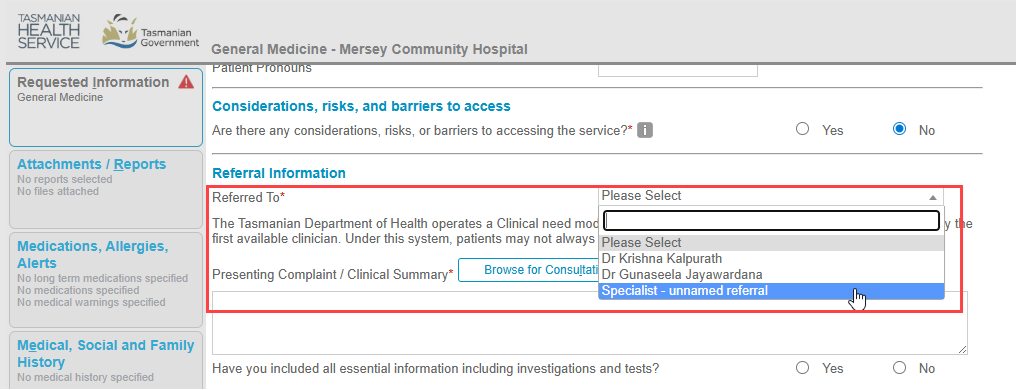
A named referral is a referral addressed to a specific specialist or consultant within the Tasmanian Health Service (THS). Using eReferral (HealthLink SmartForms), GPs can either select a named specialist where clinically appropriate or select “Specialist – unnamed referral” when referral to the specialty or service is required but no specific specialist is being requested.
Do I need to name a specialist?
Not always.
A named referral may be appropriate when:
- the patient is already known to a specialist or consultant
- there is an existing episode of care or follow-up relationship
- the GP has a clinical reason for requesting a particular specialist
- continuity of communication between the GP and specialist would support patient care
- the referral relates to a specialist’s known area of clinical expertise
If there is no clinical reason to request a specific specialist, GPs can continue to submit an unnamed referral by selecting “Specialist – unnamed referral”.
Does a named referral guarantee the patient will see that specialist?
No.
A named referral tells THS who the referral is addressed to, but it does not guarantee that the patient will be seen by that specific specialist.
All referrals are still reviewed through standard THS triage processes. A named referral may be allocated to the named specialist, or it may be redirected to another specialist within the same specialty depending on:
- clinical urgency
- service capacity
- location
- specialist availability
- clinical appropriateness
- local outpatient service arrangements
THS operates a clinical need model, which means patients are prioritised and allocated to care based on urgency and clinical suitability.
What does this mean for the patient?
A named referral may support continuity of care, particularly where the patient is already known to a specialist or where there is a clear clinical reason for requesting that specialist.
However, patients should be advised that:
- naming a specialist does not guarantee they will see that specialist
- their referral will still be triaged according to clinical need
- they may be seen by another appropriate clinician within the same specialty
- they can still access care as a public patient where eligible
Where relevant, a named referral may also support the patient’s ability to choose to be treated as a public or private patient in a public hospital outpatient setting.
What are the benefits for GPs?
Named referrals can help GPs:
- support continuity of care with known specialists
- direct referrals where there is an existing clinical relationship
- improve continuity of communication between primary care and specialist services
- make the intended referral pathway clearer
- reduce ambiguity where the referral is linked to previous specialist advice, review or follow-up
The key point is that named referrals should be used where they add clinical value, not simply as an administrative default.
What has changed in eReferral?
The specialist name field has been updated to make it easier to select from available specialists by specialty and location.
This is intended to provide a more user-friendly referral experience and reduce uncertainty when completing the referral.
If a named referral is not required, GPs can still choose:
Specialist – unnamed referral
This keeps the option of an unnamed referral available.
How are named referrals managed by THS?
Named referrals are reviewed through the same triage process as other referrals.
After review, the referral may be:
- accepted under the named specialist
- allocated to another specialist in the same specialty
- redirected according to local service arrangements
- prioritised according to clinical urgency
- returned or queried if further information is required
This means the quality and completeness of the clinical information in the referral remains more important than the specialist name alone.
What should I tell patients?
Suggested wording:
“I can address this referral to a specific specialist where there is a reason to do so, but the hospital will still triage the referral. You may not necessarily see that specialist, as appointments are allocated based on urgency, availability and the most appropriate clinician.”
And where no named specialist is required:
“I’m referring you to the specialty/service rather than to a particular specialist. The hospital will triage the referral and allocate you to the appropriate clinician.”
Legislative and administrative context
Under the National Health Reform Agreement 2026–2031, public hospital outpatient arrangements include requirements relating to referrals to named medical specialists where a patient chooses to be treated as a private patient. The Australian Government’s Federal Financial Relations site publishes the NHRA 2026–2031 consolidated addendum and related schedules.
